

Income-tax Act, 2025 • Assessment Cycle Tax Year 2026–27
- •The Income-tax Act, 2025 completely replaces the six-decade-old Income Tax Act of 1961 starting 1 April 2026.
- •The annual assessment cycle is officially termed the 'Tax Year' (1 April to 31 March).
- •Detailed provisions for Salary allow standard deductions, retirement exemptions (gratuity, leave encashment), and employer NPS matching.
- •House property taxation provides a clean 3-step calculation with a non-negotiable 30% statutory repair allowance.
- •Capital gains formula: Selling price minus acquisition cost, improvements, and transfer costs, with Section 54/54EC relief.
- •Side-by-side comparison reveals that taxpayers with high deductions (HRA, 80C, 80D, home loan interest) must evaluate the Old Regime carefully.
- •Tax evasion carries strict penalties up to 200% plus criminal prosecution for wilful default.
1. The Basics: India's New Direct Tax Framework
India has enacted a comprehensive overhaul of direct taxation with the Income-tax Act, 2025. Commencing on 1 April 2026, this legislation replaces the venerable Income Tax Act of 1961. The 12-month period for which individuals compute and remit tax is officially designated as a 'Tax Year' (1 April to 31 March).
- ✓Unified Direct Tax Architecture: Eliminates archaic clauses and consolidates schedules.
- ✓Plain-Language Statutes: Designed to minimize interpretative disputes and prolonged litigation.
- ✓Tax Year 2026–27: First operational assessment year under the newly enacted legislation.
2. Where Can Your Income Come From? (The Five Statutory Groups)
All taxable inflows are classified into five distinct statutory groups. Gross receipts are aggregated, allowable deductions are subtracted, and tax is computed on the resulting net taxable income.
| Statutory Group | Scope & Coverage | Key Governing Principle |
|---|---|---|
| Salary | Salary, wages, pension, commission, bonuses, perks and gratuity | Standard deduction applied; perks valued per prescribed formulas |
| House Property | Rental receipts from buildings or land owned by the taxpayer | Taxes paid deducted, followed by flat 30% allowance & loan interest |
| Business or Profession | Profits from running a trade, commercial enterprise, or professional practice | Legitimate operational expenses deductible; presumptive options available |
| Capital Gains | Surplus realized upon disposal of capital assets (houses, land, equity, debt) | Categorized as short or long-term based on holding duration |
| Other Sources | Interest on savings/FDs, dividends, lottery prizes, gifts, family pension | Catch-all basket; specified items subject to flat withholding rates |
3. How Each Type of Income is Taxed
Understanding the detailed rules for each source prevents accidental overpayment and avoids department queries:
3.1 Salary & Employment Remuneration
Salary income includes fixed pay, performance bonuses, commissions, pensions, and non-cash perks. Standard deduction is granted automatically to salaried persons and pensioners without requiring bills. Allowances like HRA or official travel are exempt up to defined statutory caps. Employer contributions to employee NPS accounts receive favorable tax deductions up to 10% (14% for government staff and under the new regime).
3.2 Rent from House Property or Land
Taxable rental income is calculated in four transparent steps: 1. Start with Gross Annual Rent. 2. Deduct Municipal (property) taxes actually paid in the tax year. 3. Subtract a statutory flat 30% of the remaining balance for repairs and maintenance (regardless of actual spend). 4. Deduct home-loan interest within permitted limits.
3.3 Profit from Selling Capital Assets (Capital Gains)
Capital Gain = Selling Price − (Acquisition Cost + Improvement Cost + Selling Expenses). Assets held beyond statutory cut-offs yield Long-Term Capital Gains (LTCG), while shorter holdings produce Short-Term Capital Gains (STCG). Exemption avenues include reinvesting in another house (capped at ₹10 Crore; up to ₹2 Crore for two houses once in a lifetime) or investing up to ₹50 Lakh in 54EC infrastructure bonds (NHAI/REC) within 6 months.
3.4 Other Income (Interest, Dividends, Gifts)
Interest on savings accounts, fixed deposits, company dividends, and gifts exceeding statutory thresholds fall here. Certain winnings (lotteries, online games) face flat withholding tax with zero deduction benefits.
4. Deductions: Comprehensive Catalog of Tax Reductions
A statutory deduction lets you legally subtract qualifying expenditures and investments from your gross income, reducing the base on which tax is calculated. Note that while some apply in the New Regime, many are predominantly utilized in the Old Regime:
| Statutory Deduction Category | Allowable Claim | Permitted Instruments / Conditions |
|---|---|---|
| Section 80C Basket | Up to ₹1,50,000 | PPF, ELSS Mutual Funds, Life Insurance Premium, EPF, NPS Tier-1 |
| National Pension System (NPS) | 10% or 14% of salary | Employer contribution (14% for Govt & New Regime); additional personal voluntary contribution |
| Health Insurance (80D) | ₹25,000 (₹50,000 for Senior Citizens) | Premiums for self, spouse, children; includes up to ₹5,000 preventive health check-up |
| Treatment of Serious Illnesses | ₹40,000 (₹1,00,000 for Senior Citizens) | Specified chronic or life-threatening diseases under medical certification |
| Higher Education Loan Interest | 100% of interest for up to 8 years | Loans taken for higher education of self, spouse, or children |
| Savings Bank Interest | ₹10,000 (₹50,000 for Senior Citizens) | Interest earned on resident savings bank accounts |
| Disability Deductions | ₹75,000 or ₹1,25,000 (severe) | Taxpayers or dependent family members with certified disabilities |
| Electric Vehicle & Home Loans | Statutory caps under respective sections | Interest on approved EV loans, older home loan schemes, approved charitable donations |
5. Which Tax Option Should You Choose? (New vs. Old Regime)
The New Regime is the statutory default; taxpayers wishing to utilize the Old Regime must explicitly submit an opt-in declaration at filing:
| Parameter | New Tax Regime (Default) | Old Tax Regime (Opt-In) |
|---|---|---|
| Application Mode | Applies automatically unless opted out | Requires affirmative election in return |
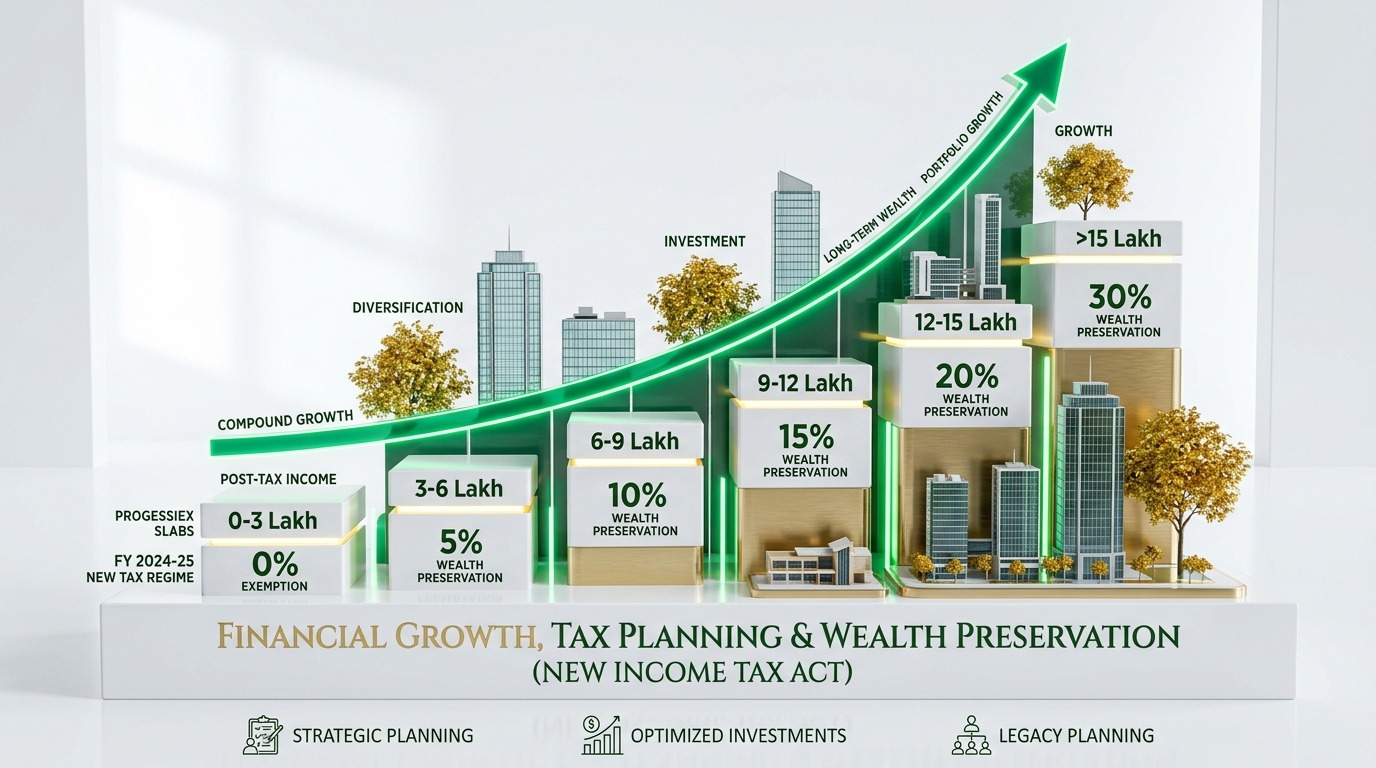
| Tax Rate Structure | Progressive graduated slabs (0% to 30%) | Higher initial rates, depends on age & residency |
| Deductions & Exemptions | Strictly limited (Standard deduction & NPS matching allowed) | Wide spectrum: 80C, 80D, HRA, LTA, 24(b) loan interest |
| Optimal Candidate | Individuals with low or zero deductible commitments | Individuals with home loans, substantial insurance, and rent claims |
6. Seven Smart and Legal Strategies to Minimize Tax
True wealth stewardship entails maximizing post-tax compound returns through authentic, legally sound tax planning:
Run a Dual-Regime Simulation Annually
Before committing your declaration, simulate your tax under both regimes using exact salary, interest, and deduction values.
Optimize Corporate Remuneration Structuring
Structure eligible benefits (car leases, employer NPS up to 14%, meal allowances) with your employer strictly within legal parameters.
Deploy Deductions Early in the Tax Year
Avoid frantic year-end cash lock-ins by staggering investments in ELSS mutual funds and NPS via systematic monthly SIPs.
Maintain Flawless Real Estate Records
Retain municipal tax payment receipts, registered lease agreements, bank statement proof of rent received, and home loan certificates.
Map Capital Gains Prior to Asset Disposal
Verify holding duration, indexation eligibility where applicable, and schedule Section 54/54EC reinvestments within the 6-month window.
Segregate Personal and Enterprise Accounts
If running a professional practice or business, maintain distinct bank accounts and evaluate presumptive taxation options.
Reconcile TDS and Advance Tax Proactively
Verify Form 26AS and AIS quarterly to ensure TDS deducted matches government records and advance tax installments are deposited on time.
7. Compliance Guardrails: Penalties and Judicial Sanctions
The Income-tax Act, 2025 provides robust deterrence against fraudulent evasion, non-disclosure, and fabricated documentation:
| Statutory Non-Compliance / Violation | Prescribed Sanction / Penalty |
|---|---|
| Unexplained money, assets or expenditure | Flat 30% tax with zero deductions or set-offs |
| Under-reporting of actual taxable income | 50% penalty of the tax amount due |
| Deliberate misreporting or fraudulent bills | 200% penalty of the tax amount due |
| Accepting cash loans ≥ ₹20k or cash receipts ≥ ₹2L | 100% penalty of the cash transaction amount |
| Deducting TDS from payees but failing to deposit | Criminal prosecution in special economic courts |
| Wilful failure to file returns after statutory notices | Prosecution and potential imprisonment |
Words Made Simple (Glossary of Tax Terms)
The standard fiscal assessment period spanning 1 April through 31 March.
A direct reduction against calculated tax liability for eligible income thresholds.
An incremental percentage levy charged on top of base tax for ultra-high income earners.
A mandatory surcharge applied on top of final tax and surcharge to fund social infrastructure.
The mandatory employer certificate showing total salary paid, components, and TDS deposited.
Judicial criminal proceedings instituted in special courts for intentional tax fraud or non-remittance.
Frequently Asked Questions (FAQ)
Q: Can I switch between the New and Old Tax Regime each year?
A: Salaried individuals with no business income can switch regimes annually at the time of filing their return. Taxpayers with business or professional income have restricted switching rights.
Q: What happens if I under-report my income?
A: Under-reporting attracts a statutory 50% penalty of the tax payable. If determined to be deliberate misreporting (using fake bills or undisclosed bank accounts), the penalty escalates to 200% plus potential prosecution.
Q: Is standard deduction available under the New Regime for Tax Year 2026–27?
A: Yes, standard deduction is automatically available for salaried employees and pensioners under both the new and old regimes.
Statutory Disclaimer: This guide is formulated for educational and general financial literacy purposes based on the published provisions of India’s Income-tax Act, 2025. Individual tax outcomes vary according to residential status, total receipts, and specific exemptions. Taxpayers are strongly advised to consult a chartered accountant or SEBI/AMFI certified advisor before making tax declarations or executing asset disposals.