

Income-tax Act, 2025 • Assessment Cycle Tax Year 2026–27
- •Tax law has been rebuilt from the ground up: The Income-tax Act 2025 comes into effect on 1 April 2026.
- •All income falls strictly into five statutory groups: Salary, House rent, Business/profession, Capital gains, and Other sources.
- •Standard deductions apply automatically to salaried individuals; 30% flat deduction applies automatically to net rental income.
- •Capital gains reinvestment allows up to ₹10 Crore exemption on residential house sales and up to ₹50 Lakh in NHAI/REC 5-year bonds.
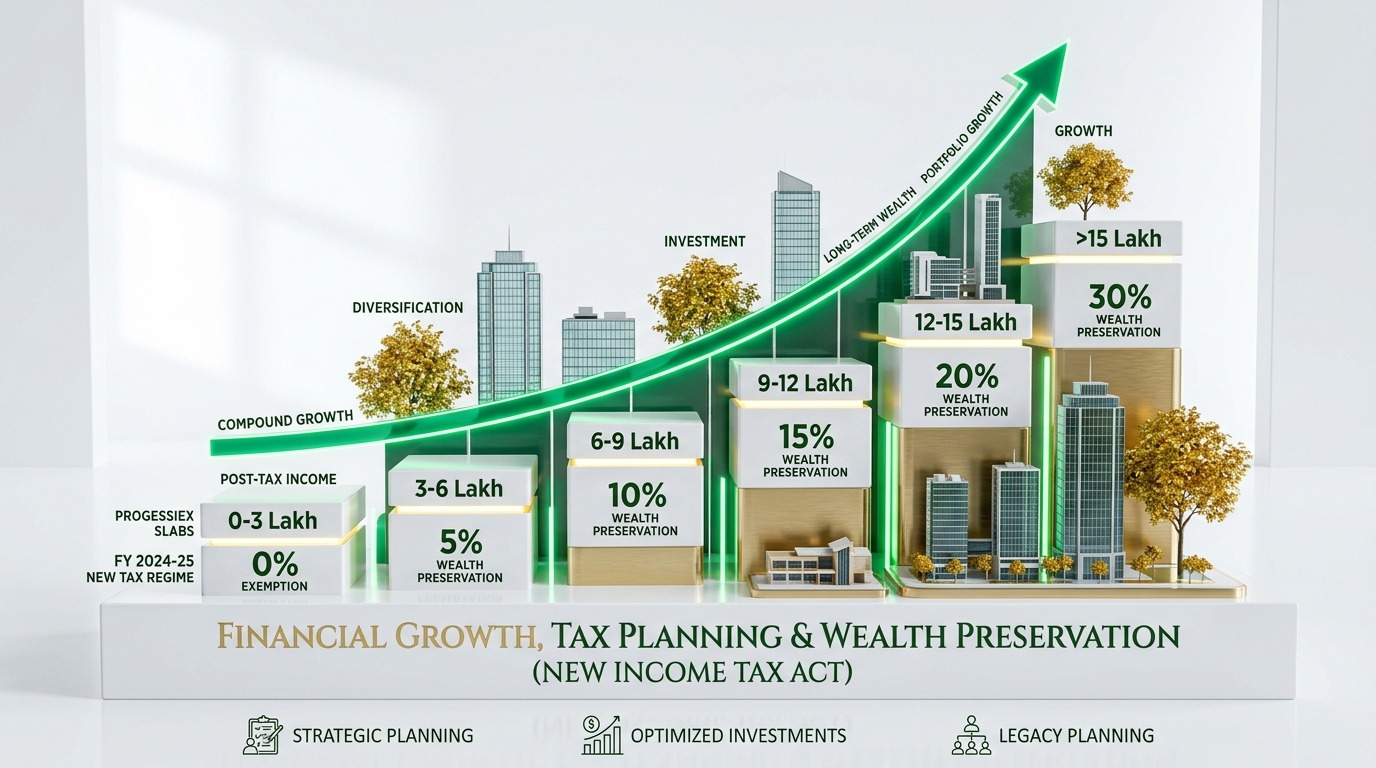
- •New tax regime is the default option with a streamlined 7-slab structure starting with 0% up to ₹4 Lakh.
- •Deliberate misreporting attracts a severe 200% penalty of tax due, while unexplained money faces a flat 30% tax with zero deductions.
Four Steps of Individual Taxation Under the 2025 Act
Add up income
Aggregate gross receipts from up to five statutory sources.
Subtract deductions
Apply allowable statutory deductions you genuinely qualify for.
Pick a regime
Compare default New Regime vs opt-in Old Regime.
Pay and file
Reconcile TDS, settle advance tax, and file on time with proof.
Five Places Your Income Can Come From
Each category has distinct statutory rules governing what is taxed and what can be subtracted:
Salary
Pay, pension, bonus, commission & perks
Standard deduction subtracted automatically. Employer NPS enjoys favorable treatment.
House Rent
Rent from buildings or land you own
Municipal tax deducted, flat 30% statutory upkeep allowance, plus home-loan interest.
Business or Profession
Profits from your proprietary work or practice
Legitimate operational expenses deductible. Separate personal vs commercial books.
Capital Gains
Profit on selling house, land, equity or shares
Short-term vs long-term rates. Exemptions available via reinvestment.
Other Sources
Savings & FD interest, dividends, winnings, gifts
Residual basket. Select items subject to special flat withholding with zero deductions.
House Rent: From Rent Received to Taxable Amount
Under the Income-tax Act, 2025, gross rent is shielded through systematic statutory deductions:
Capital Gains: Formula & Statutory Reinvestment Shields
Sell a house, buy a house
Exemption is capped at ₹10 Crore. If the total gain is up to ₹2 Crore, you may buy two residential houses (once in a lifetime).
Invest in NHAI / REC Bonds
Invest within 6 months of transfer into designated 54EC infrastructure bonds and stay locked in for 5 years.
Sell shares/funds, buy a house
Long-term capital gains from other assets can also be exempt if reinvested into residential housing under statutory conditions.
Ways to Reduce Your Taxable Income
PPF, ELSS mutual funds, life insurance premiums, and approved listed investments.
14% for Central/State govt employees and for everyone under the new regime. Extra voluntary NPS also permitted.
₹50,000 for senior citizens. Includes up to ₹5,000 preventive health check-up.
Treatment of specified serious medical conditions (₹1 Lakh for senior citizens).
100% of interest paid on an education loan for up to 8 continuous years.
Interest earned on resident bank savings accounts (₹50k for seniors).
What You Must Not Do, and What It Costs
The Income-tax Act, 2025 provides severe statutory penalties for suppression of income and fabricated claims:
Unexplained deposits, undisclosed assets or unverified spending. Zero deductions allowed.
Penalty calculated as 50% of the additional tax due.
100% of loans ≥ ₹20,000 or receipts ≥ ₹2 Lakh taken in cash where prohibited.
Double the tax due for forged certificates, fake bills, or concealing key facts.
- ✕ Deducting TDS but not depositing it with government
- ✕ Wilfully evading tax or its payment
- ✕ Wilfully not filing your return after notices
- ✕ Giving a false declaration or verification
Seven Legal Ways to Pay Less Tax
Compare both regimes every year
Look at salary, home-loan interest, investments, insurance and pension contributions before deciding.
Use salary benefits properly
Ensure any changes to your corporate salary structure are genuine and fully comply with the rules.
Invest before the year ends
Review savings, pension and retirement contributions and claim only what legitimately qualifies.
Keep property papers ready
Rent agreements, loan-interest certificates and municipal tax payment receipts.
Plan before you sell
Check holding periods, capital gain amounts, tax rates, and Section 54/54EC reinvestment exemptions.
Keep business records pristine
Separate personal and business spending, claim only genuine expenses, and assess presumptive schemes.
Stay on top of payments and filing
Verify TDS in AIS/26AS, remit advance tax on time, and match declared income with bank records.
Words Made Simple (Glossary of Tax Terms)
The 12-month period (1 April to 31 March) for which income is assessed and tax calculated.
Gross total income minus all permissible deductions and exemptions allowed by the law.
Tax withheld by your employer, bank, or payer and credited to the government on your PAN account.
Tax paid in quarterly installments during the financial year when TDS does not cover your overall tax liability.
Non-cash perks or benefits provided by an employer, such as company cars or accommodation, valued by statutory rules.
Frequently Asked Questions (FAQ)
Q: When does the new Income-tax Act, 2025 take effect?
A: The Act comes into legal force on 1 April 2026, governing assessments for Tax Year 2026–27 onwards.
Q: Is the new regime mandatory?
A: No, the new regime is the automatic default, but individual taxpayers may opt into the old regime if their allowable deductions make it more tax-efficient.
Q: What is the maximum exemption when reinvesting capital gains from a house?
A: The statutory exemption is capped at ₹10 Crore under the new Act. Up to ₹2 Crore can be deployed into two residential properties once in a lifetime.
Statutory Disclaimer: This guide is formulated for educational and general financial literacy purposes based on the published provisions of India’s Income-tax Act, 2025. Individual tax outcomes vary according to residential status, total receipts, and specific exemptions. Taxpayers are strongly advised to consult a chartered accountant or SEBI/AMFI certified advisor before making tax declarations or executing asset disposals.